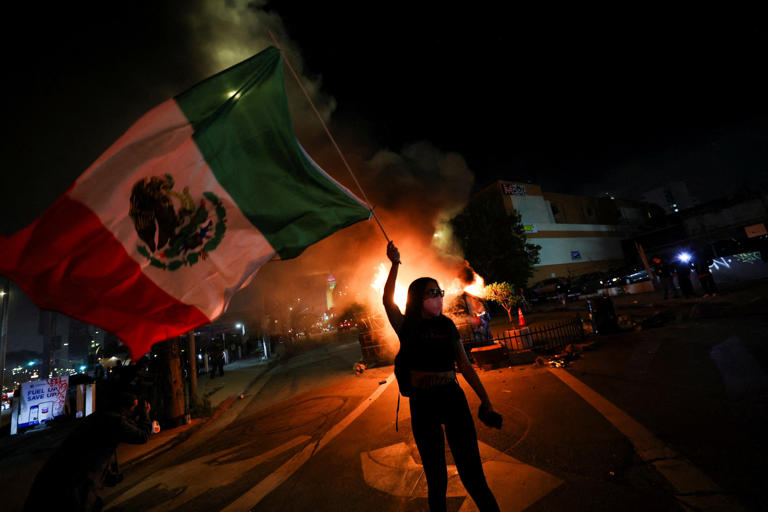
Protester in downtown Los Angeles, California, on June 8, 2025. © Aude Guerrucci (REUTERS)
The protests of migrants in California against the persecutions triggered by Donald Trump are spreading to other capitals of the United States, where millions of Mexicans live and work, many under the threat of deportation, and they are creating a political wave that is strongly felt in Mexico, both in human and economic aspects.
The negotiations between both countries, which have been tense for months due to tariffs, have taken a sharp turn towards immigration issues with thorny statements from all sides, including accusations from U.S. Secretary of Security Kristi Noem, who has accused Claudia Sheinbaum of instigating violence in California, something that the president has emphatically denied.
All governors of Mexico, regardless of their political party, have signed an institutional letter of support for the president. «He’s never called for violent protests; on the contrary, he’s always stressed the importance of dialogue as a way to resolve differences,» they said.

The always difficult bilateral relations have now become entangled in the remittances sent by migrants to their Mexican families and the possibility of taxing them with a 3.5% fee. This and the persecutions against migrants have stirred the eternal political hornet’s nest. If, as some analysts suggest, there are underlying nerves about next year’s electoral call in the United States, as that date approaches, Mexico will endure long months under crossfire between Democrats and Republicans, with migration being the battering ram in the fight, as it is in every campaign.
Trump doesn’t need elections to stoke the fire, anyway. He has been doing this since he won the presidency, and immigration is kindling in the claims of many of his supporters.
Not only Kristi Noem’s words have raised waves. Republican senators like Eric Schmitt are reveling in the taxes on remittances, directly alluding to the anger that this will provoke in Sheinbaum.
Mexicans are once again closing ranks in the face of an external enemy. Alongside the institutional letter signed by the governors, which seeks to ease tensions in relations between the two countries, they reaffirm their commitment to national unity and international cooperation. This is complemented by statements from the president of Morena, María Luisa Alcalde, who has come out to defend her leader, reminding that neither she nor the party has ever promoted violence. In the lower house, the Morena representatives have drafted a letter condemning the situation their fellow citizens abroad are experiencing, which they intend to send to the Representatives of the United States; however, they will first seek to reach a consensus with the other political parties to present a united front. Meanwhile, the Morena senators discussed this Tuesday the possibility of a demonstration in front of the U.S. embassy on Reforma avenue in the capital city.
Ultimately, there was dissent, and those plans were thwarted. This withdrawal and the support from all fronts for the pacifism upheld by the president appear aimed at cooling the upheaval that has erupted over the past three days with the protests of migrants, which does nothing to assist Mexico in its economic negotiations.
«The Mexican flags waved in the Angelino demonstrations are doing a disservice to Mexico, putting it in a disadvantageous position for further negotiations,» says Arturo Rocha, who was the director general of Human Mobilizations in the previous Mexican foreign ministry. He believes that the strategy of ‘keeping a cool head’ that has characterized Mexico’s position in its relations with Donald Trump should continue. He thinks that those flags seen in all the photographs represent a ‘strategic error of the Mexican community in Los Angeles that, in addition to being risky for them given the totalitarian drift of the Republican, may have repercussions in negotiations and only provide ammunition to the anti-immigrant electorate, which is already in xenophobic positions,’ notes the former official, who believes that Sheinbaum’s statements about the pacifism that should prevail in the mobilizations is the right path.
Around 62 billion dollars enter Mexico each year in remittances, and a 3.5% tax like the one being discussed in the U.S. House of Representatives would create a huge hole in the Mexican economy. Not everything has been said yet about the latest 50% tariffs imposed on Mexican steel and aluminum exports, for example. The latest news indicates that Trump could backtrack and return to the same conditions that existed when he first governed. Any escalation could harm the difficult economic path that Mexico is navigating with its main partner. What is happening in California and other cities ‘is tough and concerning, because it is evident that the United States is using it as a pretext to commit abuses, with arbitrary and racist measures.’
In authoritarian systems, crises are manufactured to make use of extralegal figures in favor of power,” says Rocha. And the Californian example seems relevant to him because troops are being sent that have not even been requested by the state, given the peaceful nature of the mobilizations.
According to Rocha, Mexico needs to clarify the strategy to follow and make more forceful calls for the respect of Mexicans there, especially those who may end up in jail and be deported to third countries with little protection of human rights. That is the key point on which they should focus the dialogue, says the former official. “It’s not about,” he claims, “raising the tone, but clearly rejecting violence in the protests is indeed a success.”