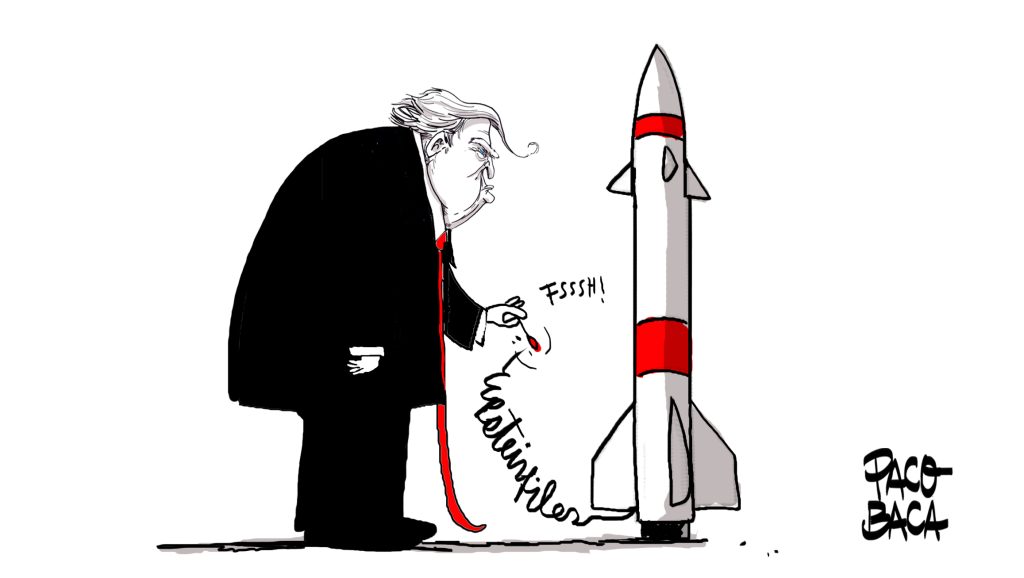
Editorial and cartoon by Paco Baca.
Recent history has become a labyrinth where Donald Trump advances without a compass. On February 28, 2026, following the death of Ali Khamenei, Iran entered a delicate transition with Masoud Pezeshkian as interim leader. That same day, joint U.S. and Israeli bombings on Tehran and Sanandaj marked the beginning of an escalation that has not ceased.
By March 1, Iran rejected any negotiation with Washington. Two days later, Kuwait mistakenly shot down U.S. aircraft, exposing how fragile regional alliances truly are. On March 20, Tomahawk missiles from the USS Delbert D. Black struck Iranian military facilities, confirming that war was no longer a hypothetical scenario but a devastating reality.
The numbers speak for themselves: more than 40 airstrikes in three weeks, 600 Iranian civilians killed according to the UN, 35 U.S. soldiers wounded and 12 dead in bases across Iraq and Syria, and over 20 ballistic missiles raining down on Israel, leaving Tel Aviv and Haifa in ruins.
Trump insists he is “setting conditions,” but images of burning bases and devastated cities contradict any narrative of control. Netanyahu appears to be writing the script, dragging Washington into a full-scale war against Iran. Meanwhile, Jeffrey Epstein’s files continue to surface in the international press—an uncomfortable reminder the White House tries to overshadow with the noise of war.
The result is chaos with no exit. Trump, trapped between Netanyahu’s orders and his desperate attempt to divert media attention, has become entangled in a conflict he does not understand. Bombs do not erase scandals—they amplify them. In plain terms: the tangled web Trump has stepped into is already too tight to escape.