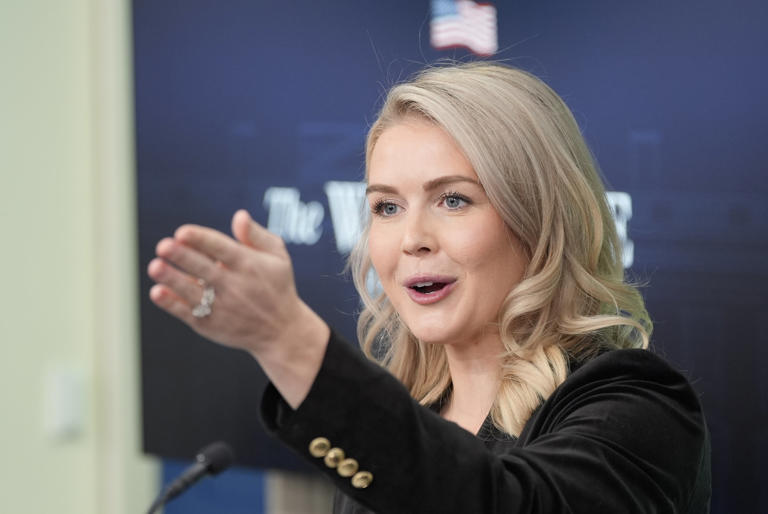
Karoline Leavitt at the White House in Washington on Thursday. © Alex Brandon (AP)
Hardly a day goes by without Donald Trump expressing his desire to intervene in Mexico from the White House. He either does so directly or uses euphemisms such as ‘help’ or ‘military assistance’ in the fight against organised crime. On Thursday, Karoline Leavitt, the White House spokeswoman, opted for a disturbing ellipsis when asked how far they are willing to go in Mexico. She spoke of ‘additional measures’, while also reminding us that ‘it is a promise the president made to the American people’. The previous day, Stephen Miller, the influential deputy chief of staff at the White House, was more explicit when he compared the current campaign against drug trafficking, or ‘narco-terrorism’, to the fight against terrorism.
Earlier this week, Trump himself said that he would agree to launch attacks on Mexican territory similar to those he has ordered in the Pacific and Caribbean. President Sheinbaum responded to the Republican tycoon as she always does when there is an increase in hostility from the White House. «It’s not going to happen,» said the Mexican leader.
The latest attacks have been encouraged by various figures in the MAGA movement. Several of its spokespersons, including Steve Bannon and Alex Jones, have exploited Saturday’s anti-government protests in Mexico to advocate a heavy-handed approach on the other side of the border. Indeed, Trump’s representatives have adopted some of the slogans that were most frequently repeated during the march, such as the claim that Mexico is a «narco-government». The Mexican government has accused international far-right organisations of orchestrating the supposedly spontaneous protests led by young people.
Trump’s campaign against drug trafficking has had a legal framework in place since the beginning of this year. The campaign focuses heavily on three countries that are not exactly allies in the region: Mexico, Colombia and Venezuela. In January, a decree classified several criminal organisations, including six Mexican mafia groups, as terrorist organisations. In theory, this measure paved the way for military intervention in other countries.
So far this year, the White House has sunk more than 20 alleged drug boats in Caribbean and Pacific waters, resulting in at least 80 extrajudicial killings. Against this backdrop, Leavitt’s comments on Thursday regarding Mexico and the «additional measures that the president reserves» took on greater significance. The White House spokeswoman began, as usual, with a compliment to Sheinbaum, before delivering the blow. ‘The president has been very cooperative in the fight against illegal immigration and drugs on the southern border. In any case, the president is very interested in taking additional measures. He has said so several times; he has been clear. It is a promise he has made to the American people. His national security team is discussing it.’
Miller, who often describes Mexico as a state ‘run by criminal cartels’, expressed a similar view. He insisted that ‘the entire stretch of our southern border on the Mexican side is under the control of these narco-terrorist organisations’. They decide and control what happens there. There is no more essential national security issue than dismantling these organisations.’ He added that, just as the United States used military forces and resources to target Al-Qaeda and Islamic State, the same approach could be taken against the cartels controlling territory in this hemisphere, who have their own forces and shape political outcomes by assassinating leaders at will to dominate entire governments.