On June 15, 2026, a peace agreement was signed between the United States and Iran, which includes the reopening of the Strait of Hormuz. This agreement was confirmed by U.S. President Donald Trump and Pakistan’s Prime Minister Shehbaz Sharif, who acted as mediator in the negotiations.
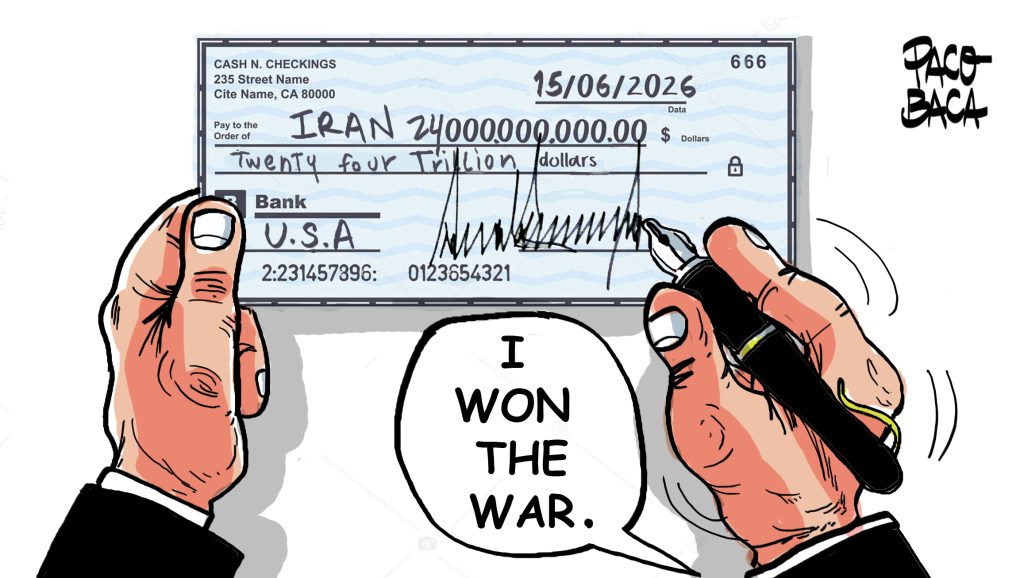
The so‑called peace treaty between Trump and Iran’s military leader over the Strait of Hormuz was less diplomacy than accounting. What was presented as a solemn handshake was, in truth, a transaction. Sovereignty and national pride vanished the moment a check with more zeros than casualties appeared on the table.
Trump, who once promised “fire and fury,” now smiles like a banker closing a deal. The Iranian general, who swore eternal resistance, signs with a steady hand—because resistance suddenly became negotiable once the deposit cleared.
The war evaporated faster than ink in water. Sunken ships, apocalyptic threats, anonymous dead—all reduced to footnotes. Oil flows again, markets breathe, and speeches twist themselves into knots to justify the unjustifiable.
What to know about the Iran war:
- The memorandum of understanding outlining the U.S.-Iran deal has been signed electronically by both sides, U.S. officials say, and a signing ceremony is expected on Friday.
- Iran’s powerful Revolutionary Guard said under the agreement, the country will receive half of its roughly $24 billion in long-frozen funds before final negotiations begin during a 60-day ceasefire extension. A U.S. official said earlier that Iran will get none of the money until it demonstrates compliance with the deal’s terms.
- Israeli officials said the country is not bound by the agreement between the U.S. and Iran to end its fight with Hezbollah or to pull its forces out of Lebanon. President Trump, Pakistani mediators and Iran have said the deal includes a cessation of hostilities on all fronts, including in Lebanon.
From Tehran, Deputy Foreign Minister Kazem Gharibabadi also ratified the understanding and stated that the final document will be signed in Switzerland. The official further confirmed the end of hostilities and the lifting of maritime restrictions imposed during the conflict.
As Quevedo warned centuries ago: “Poderoso caballero es don dinero”—money is the mighty knight. It turns enemies into partners, wars into treaties, and principles into soggy paper. The Strait of Hormuz did not reopen through courage or diplomacy, but because someone paid the bill.
And Trump, pen in one hand and check in the other, declares with a grin: “I won the war.”
Editorial Note
While this editorial refers to a “check” or payment as the driving force behind the peace agreement, it is important to clarify that no official figure has been confirmed by the United States, Iran, or mediators involved in the negotiations. The reference to money is used here as a satirical and critical device, highlighting the perception that financial interests often outweigh principles in international diplomacy.
The factual elements of the agreement remain:
- Signed on June 15, 2026 between the United States and Iran.
- Includes the reopening of the Strait of Hormuz.
- Confirmed by U.S. President Donald Trump and Pakistan’s Prime Minister Shehbaz Sharif, acting as mediator.
- Ratified in Tehran by Deputy Foreign Minister Kazem Gharibabadi, with the final document to be signed in Switzerland.
This distinction ensures the editorial maintains its critical voice while staying anchored in verified reporting.