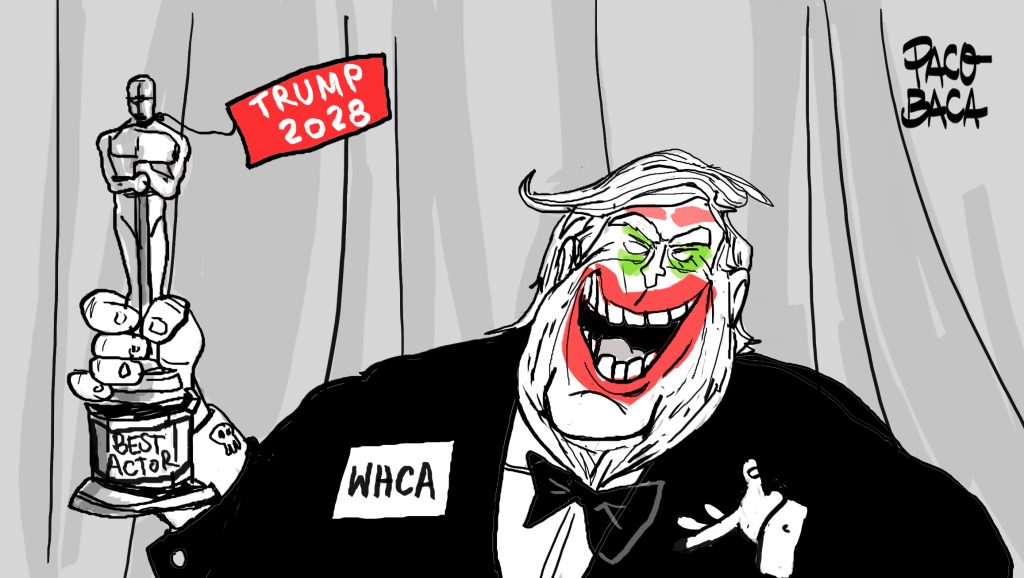
Trump and His Third Term: The Joke That Isn’t a Joke
“When power laughs at satire, democracy risks becoming the punchline.”
Washington, White House Correspondents’ Dinner. Between glasses of wine and bursts of laughter, Donald Trump casually dropped the line—like an after‑dinner joke—that he might run for president a third time. The room laughed, the cameras flashed, and reporters scribbled nervously: was it humor, rehearsal, or a warning?
The irony is that the U.S. Constitution sets a hard limit of two terms. The Twenty‑Second Amendment, ratified in 1951 after Franklin D. Roosevelt’s unprecedented four consecutive terms, was designed to prevent leaders from becoming permanent fixtures in power. Roosevelt had governed through four elections, and the country understood that democracy requires rotation, not perpetuity. Trump, ever the salesman of illusions, toys with the idea that rules are just paper if he decides to rewrite them.
This is not the first time a leader has flirted with eternity. In Russia, Vladimir Putin turned political alternation into a game of musical chairs where he always wins. In China, Xi Jinping erased term limits with the stroke of a pen. In Nicaragua, Daniel Ortega made reelection routine. Latin America knows this script well: Porfirio Díaz in Mexico, who swore “no reelection” while clinging to power; Juan Domingo Perón in Argentina, returning as myth and shadow; and more recently Evo Morales in Bolivia, stretching legality until the rope snapped.
The sarcasm writes itself: a nation that prides itself on being the cradle of institutions applauding the whim of a man who already proved that institutions bend when pushed by enough ego. Trump’s “third term” is not a joke—it’s a dress rehearsal.
The moral is blunt: when a politician jokes about absolute power, he isn’t joking—he’s testing the laughter of the crowd. And if the laughter is loud, the danger is real. In politics, jokes are often the most comfortable disguise for the most serious ambitions.
The Correspondents’ Dinner, meant to be satire aimed at power, became a stage where power laughed at satire. That’s the real risk: democracy turning into spectacle, with the audience clapping, unaware that the play is actually a tragedy in progress.
The academic irony is clear: the Constitution was written to prevent monarchs disguised as presidents, and the dinner was born to remind power it is not above criticism. When both traditions become the backdrop for a joke about perpetuity, the result is an uncomfortable mirror: democracy laughing at itself, while the would‑be eternal smiles in satisfaction.
—Paco Baca, RocketMedia.News